Voxaris Blog
Why AI Recommends the Contractor With Fewer Reviews
The contractor AI names isn't the one with the best reviews. It's the one doing the work. A real case: no website to #1, past a 5-star competitor.
When someone asks ChatGPT or Google's AI for the best contractor in their area, the business it names is usually not the one with the most reviews or the biggest brand. It's the one that's been putting out real, consistent, quality content — because that's what AI reads to decide who actually knows their trade. Reviews barely move that needle. I've watched a business at 4.9 stars get recommended over a competitor sitting at a perfect 5.0, for exactly that reason.
I'll be honest about where I'm coming from on this. I'm not a 20-year agency owner. I've got one thing I know cold, and it came from doing it, not reading about it: consistent organic posting, always putting out new content, wins. That's the whole game most people are overcomplicating.
The business AI names is the one doing the work
Here's the part that trips people up. Everyone assumes AI search runs on the same signals as the old Google — reviews, backlinks, domain age, whoever's been around longest. So the big established company with 400 reviews assumes it wins by default.
It doesn't. AI is closer to a human than a search algorithm. Ask a knowledgeable person who the best drywall contractor in town is, and they don't recite whoever has the most stars. They name whoever they've seen actually demonstrate they know the work. AI does the same thing — it reads what you've published, and it recommends the source that reads like an expert instead of the source that reads like everyone else.
That's why the newer, hungrier contractor keeps beating the incumbent. The newcomer has less brand, so they try harder. They post consistently. The big companies get complacent — at least in the trades, that's exactly what I see. They coast on their name, they post rarely, they don't keep a real blog, and when they do publish something, it's the same saturated take everyone else already wrote. AI has no reason to cite the fourth copy of an answer it already has.
A real example: no website to #1, past a higher-rated competitor
Before working with Voxaris, Toronto2Florida Drywall Services didn't have a website at all. Just a Google Business Profile. That's it.
Today they rank #1 across an entire 25-point, 100-square-mile geo-grid for "Clermont drywall companies" — a perfect 1.00 Average Rank Position and 100% Share of Local Voice. Wherever a customer in that whole area searches, T2FDS shows up first.
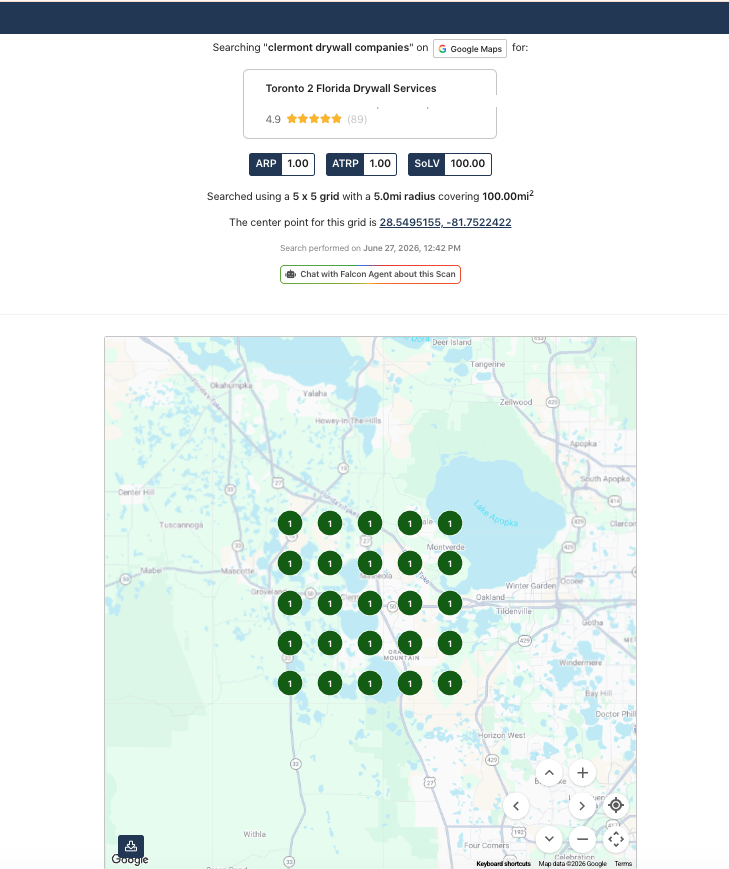
Now look at who they're beating. T2FDS sits at 4.9 stars across 89 reviews. The competitor right below them, Central Florida Drywall, has a perfect 5.0 across 87 reviews — a higher rating, basically the same review count — and it ranks under T2FDS. If reviews were the deciding factor, that's flipped. They're not the deciding factor.
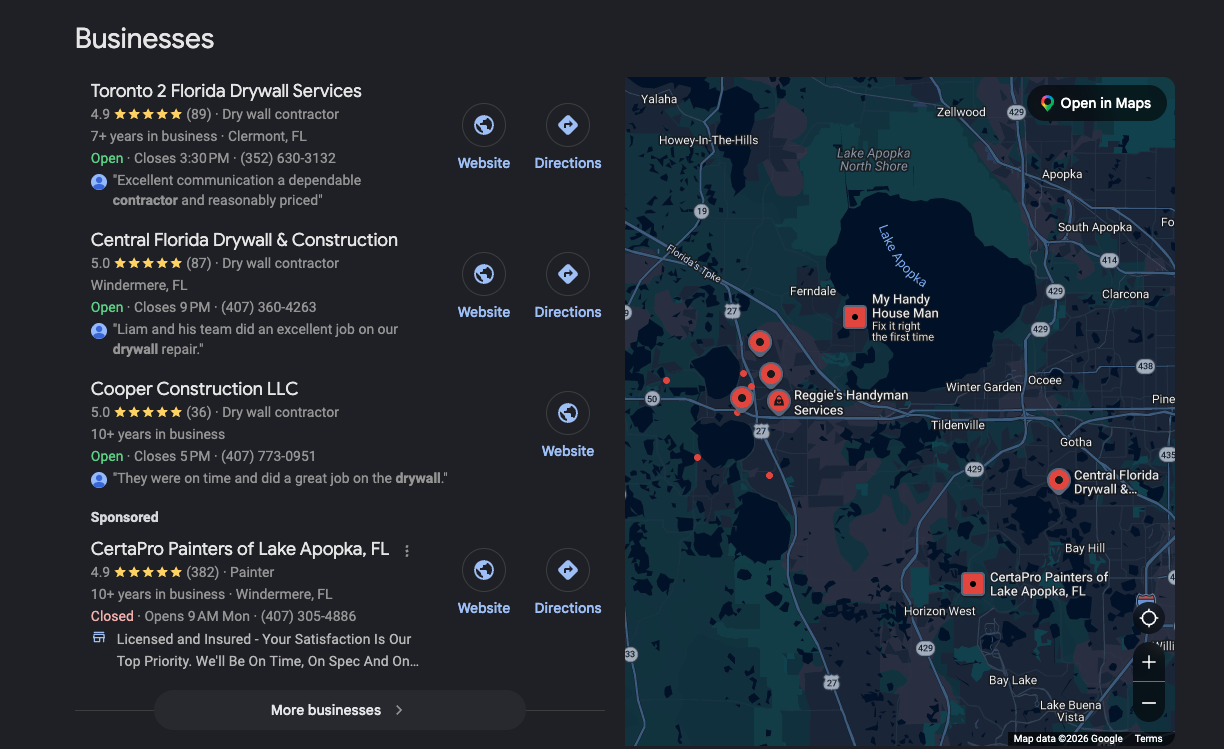
What changed for T2FDS wasn't reviews. It was that they went from zero web presence to consistently publishing content a machine can read and trust — and Google's own AI Overview now describes them by name when someone searches their services. A business that had nothing a short time ago is the one AI recommends, over contractors who've been in business for years.
The thing agencies won't tell you: the code is the floor, not the finish
Ask most agencies why you're not showing up in AI search and you'll get the same answer: it's in the code. Add schema markup. Add an llms.txt file. Fix your robots.txt. And that's it, like the technical setup is the whole job.
That stuff matters. It's also table stakes. It's the floor you have to be standing on before anything else counts — not the thing that wins. I think a lot of people get so hyper-focused on the technical side that they believe it's all that matters, and then they wonder why nothing's citing them. You can have flawless schema on a site that's said nothing worth quoting.
What the technical crowd is missing is the part that's actually hard to fake: quality content, published consistently, that adds something. That's the moat, because it's the one thing your competitors can't shortcut. Anyone can generate a schema tag in thirty seconds. Anyone can have ChatGPT write a generic blog. What they can't manufacture is the time and the actual expertise it takes to say something the internet doesn't already have ten copies of.
What "authority gain" actually means
This is the concept I keep coming back to, and it's the whole strategy: authority gain means giving more than what's already out there. You don't just match the existing answer — you add on top of it.
If every page on the internet says "the average cost is $50 to $80," you don't publish a page that also says $50 to $80. You publish the one that says the average is $50 to $80, but it can run over $100 when the job involves X, and here's exactly when that happens. Now yours is the more complete answer. When AI is deciding which source to pull from, it takes the one that goes further, because that's the one that reads like the expert in the room.
That's the difference between being one of the crowd and being the source. AI wants quality expert opinions, not the same washed-up take restated for the fifth time. Every time you add real information on top of the standard answer, you become a little more citable and everyone repeating the consensus becomes a little less.
But don't the big, established contractors win by default?
For a while, yes. Brand and history carry an incumbent a long way — right up until someone hungrier starts actually doing the work. The established company wins by default, and then it gets passed by the one trying harder. Default is not a moat. Effort is.
How often should you actually post?
As much as you can, as long as the quality holds. That's the entire rule.
If you can put out two genuinely good pieces a day, do it. If your ceiling is one solid piece a day, or one every other day, do that instead — and don't force more. The second you start trading quality for volume, you've lost the plot, because AI is reading for quality, not counting posts. Consistency and quality together is what compounds. Consistency alone, cranking out saturated filler, just teaches the machine you're another voice repeating the obvious.
The one rule
Quality over quantity, every time. AI is like a person deciding who to trust — it wants the expert opinion, not the recycled one. Do the work, add more than what's already there, and keep doing it. That's the whole answer, and it's the part almost nobody has the patience for.
See where you actually stand in AI search
The fastest way to know whether AI is naming you or your competitor is to check. Voxaris runs an AI Visibility Teardown that shows exactly which searches you show up in across ChatGPT, Perplexity, Gemini, and Google AI Overviews — and where your competitors are winning when you don't.
👉 Get your AI Visibility Teardown at voxaris.io/audit — or, if you're weighing whether to build this yourself, read Should You Hire an SEO Agency or Do Your Own Marketing as a Contractor? for the honest cost breakdown.
Frequently Asked Questions
Does AI search rank businesses by number of reviews?
No. Reviews are a supporting signal, not the deciding one. AI reads the content a business publishes to judge expertise, which is why a business with a slightly lower rating or fewer reviews can outrank a higher-rated competitor — as happened with a 4.9-star contractor ranking above a 5.0-star one in the same market.
If reviews don't decide AI rankings, what does?
Consistent, high-quality content that demonstrates real expertise — and adds more than the standard answer already available online. AI recommends the source that reads like the expert, not the one that repeats what everyone else has already said.
Isn't AI search just about schema markup and technical setup?
Technical setup (schema, llms.txt, robots.txt) is necessary but it's the floor, not the finish. It gets you eligible to be read. What actually earns the citation is the quality and consistency of what you publish. Sites with perfect technical setup and nothing worth quoting still don't get cited.
How often should a contractor publish content for AI search?
As often as you can while keeping the quality high. Two quality pieces a day is better than one; one a day is better than one a week — but never sacrifice quality for volume, because AI reads for quality, not post count.
What is "authority gain"?
Authority gain is publishing content that goes beyond the existing answer instead of matching it. If the consensus says a cost is "$50 to $80," the authority-gain version says that, then adds when and why it can exceed $100. AI pulls from the more complete source, so adding real information on top of the standard answer makes you more citable over time.
About the author
Written by Ethan Stopperich, Founder of Voxaris AI. Voxaris helps home-service contractors get found and cited by AI search — ChatGPT, Perplexity, Gemini, and Google AI Overviews — through consistent, quality content and the technical foundation to back it.
Connect on LinkedIn · X · voxaris.io
Last updated: July 14, 2026
Try it live
See it run on a roof you know.
Bring any address — yours, a customer's, a famous one. We'll show you the estimator measuring and pricing it live, on your branding, and get you set up, month to month.